
26 Nov Canada launches CAD 750 million greenhouse program
Canada’s controlled-environment agriculture (CEA), often called 'indoor farming', industry is mainly concentrated in specific regions. The municipality of Leamington in Essex County and the Niagara region of Ontario are well known for the greenhouse production of vegetables and ornamental plants. Indeed, NCCC Patron member Priva are located next to the QEW highway in the Niagara region. Greenhouse cultivation is also growing in British Columbia, Quebec, and Alberta.
In June 2026, the Canadian government announced its National Food Security Strategy, which includes CAD 750 million in support for controlled-environment agriculture. The aim is to strengthen food security and reduce dependence on imported fresh produce.
In October 2026, Minister of Agriculture and Agri-Food Heath MacDonald launched the CEA Growth Pathway Program. Of the CAD 750 million, CAD 650 million will support the adoption, expansion and modernization of CEA infrastructure and technologies, including automation, robotics, lighting, and digital growing tools. Another CAD 100 million will support locally driven food production in rural and northern communities and improve access to fresh food. The Netherlands Agricultural Network (LAN) team can refer Dutch businesses to regional officials of Agriculture and Agri-Food Canada’s Market and Industry Services Branch for information on funding opportunities and eligibility.
“Controlled environment agriculture is transforming how food is grown in Canada. By investing in year-round production of fresh fruits and vegetables closer to home, these technologies will strengthen food security, create jobs, and support economic growth in communities across the country. Our government will continue investing in innovative solutions that strengthen our domestic food system and ensure Canadians have access to fresh, high-quality, domestic food for generations to come.”
- The Honourable Heath MacDonald, Minister of Agriculture and Agri-Food
Unlike in the US, labour availability is less of a problem for some Canadian growers because regulations allow them to hire seasonal foreign workers. Provincial governments, regional greenhouse associations, and education and research institutions are nevertheless encouraging innovation in CEA, as businesses still need to improve efficiency.
‘Canada is investing in greenhouse technology to produce more food domestically and reduce dependence on imports’
Canadian researchers test tomato robots and LED lighting
The University of Guelph is known for agricultural and horticultural research, including automation and robots that pick tomatoes in greenhouses. It also conducts extensive research on LED lighting for greenhouses and indoor farms, including applications in space. Vineland Research and Innovation Centre and Niagara College in Ontario carry out applied research with partners.
New CEA test facilities have been built at Niagara College, where private companies, including Dutch businesses, can test new plant varieties, products and technologies while involving students in research.
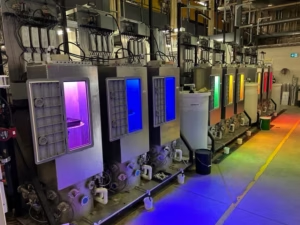
Research at Agricultural University in Guelph, Canada
US flower tariffs slow Canadian greenhouse investment
An important threat to Canadian cut-flower growers is the additional 50% US tariff imposed on specified Canadian cut flowers and some live plants which came into effect on August 22, 2026. Many ornamental growers export between 70% and 90% of their cut flowers and orchids to the US. These tariffs are making growers more reluctant to invest in floriculture. The tariffs cover specified cut flowers and some live plants, including orchids, but do not apply uniformly to all potted plants and fresh vegetables. Large US retail chains still depend heavily on imports of fresh vegetables from Mexico and Canada.
Canadian Greenhouse Conference brings companies together
The annual Canadian Greenhouse Conference (CGC) took place in Niagara Falls, in the heart of Ontario’s greenhouse region, during the first week of October 2026. More than 300 exhibitors attended, and sessions covered a range of new horticultural technologies. Dutch companies and visitors were well represented. The LAN team in Washington, DC, and Vancouver organized a networking event in Niagara Falls with colleagues from the Netherlands Consulate in Toronto. Like GreenTech North America, the CGC brings together businesses, researchers, knowledge institutions and public agencies to share information about developments in CEA. Participants can learn about the latest technologies. The next CGC is planned for early October 2027 in Niagara Falls.
In October 2026, a new Partners for International Business (PIB) project, Grower of the Future, was approved to help Dutch greenhouse companies develop business in Ontario, Quebec and British Columbia. The project is partly funded through the Netherlands Enterprise Agency (RVO).
Linking North American partners with Dutch growers
The LAN team helps strengthen the Dutch greenhouse industry by connecting partners across the Atlantic. The team identifies emerging trends and brings together businesses, researchers, and governments. It also supports innovation missions and research cooperation and helps Dutch stakeholders gain access to new knowledge and opportunities.
The team is currently exploring new collaborations between Dutch and Canadian knowledge institutions and businesses and hopes to see further developments in 2027. These activities contribute to technological development, sustainability, and economic resilience.
More information
For more information about greenhouse innovation and opportunities in Canada, you can go to the country pages for Canada. You can also send an email to the LAN team in Vancouver: van-lvvn@minbuza.nl.
Sorry, the comment form is closed at this time.